
Darts scoring explained clearly and simply along with the rules for playing darts is what most players want when they first step up to a dartboard. The board looks confusing. The numbers jump around. People shout things like T20 and Double 16 and somehow subtract faster than a calculator.
How ever once you understand how scoring works darts becomes one of the most satisfying games in the world. Whether you are playing casually at home competing in league play or watching the pros from the Professional Darts Corporation or the World Darts Federation scoring is the heart of the game.
So let’s break everything down step by step from 501 and 301 to Cricket in a way that actually makes sense.
How Dartboard Scoring Works in the Rules for Playing Darts
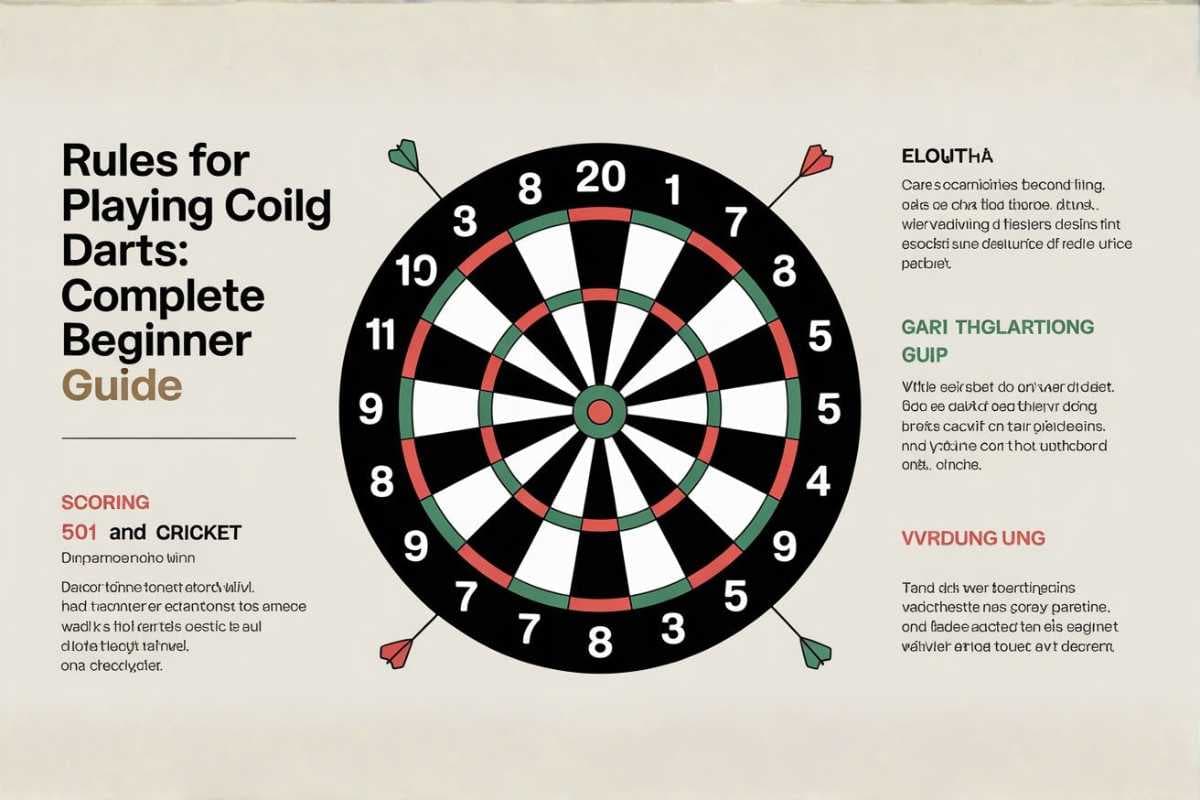
Before diving into 501, 301 or Cricket you need to understand the dart board itself. A standard regulation dart board usually made from bristle or sisal fibers contains numbers 1 through 20 arranged around the board in a specific order. Each number has different scoring areas including a large single area a thin outer double ring and a thin inner triple ring. At the center you will find the outer bull worth 25 points and the inner bull worth 50 points.
When you hit a single 20 you score 20 points how ever if you hit the double 20 you score 40 points and if you land in the triple 20 you score 60 points. Because triple 20 (T20) offers the highest possible score with one dart most players aim there first to maximize points quickly. Each player throws three darts per turn from behind the oche also called the throw line which is placed 7 feet 9.25 inches (2.37 meters) away from the board.
Additionally the center of the board must be mounted at a height of 5 feet 8 inches (1.73 meters) from the floor to meet official standards set by organizations such as the Professional Darts Corporation and the World Darts Federation. Now that the board setup and scoring areas are clear it becomes much easier to understand how popular formats like 501, 301 and Cricket actually work.
501 Scoring Explained (Standard 501)
In Standard 501 each player starts with 501 points and subtracts their score every turn aiming to reach exactly zero according to the official rules for playing darts. How ever the game can only be won by finishing on a double which adds pressure and strategy to every throw.
What Is 501?
501 is the most common professional format. In fact all major tournaments under the PDC World Darts Championship use it. Each player starts with 501 points. The goal? Subtract your score down to exactly zero rules for playing darts.
How Scoring Works in 501
- Players subtract their score each turn.
- You can score up to 180 points in one turn (T20 × 3).
- The player must finish on a double.
For example:
- If you have 40 remaining → You must hit Double 20.
- If you have 32 remaining → Double 16 wins.
This is called double out.
What Is a Bust in 501?
A bust happens when:
- You score more than your remaining total.
- You reduce your score to 1.
- You reach 0 without finishing on a double.
When this happens your score resets to what it was before the turn. This rule adds pressure. You must calculate carefully.
Common 501 Checkout Examples
- 170 checkout → T20 T20 Bull (maximum finish)
- 100 checkout → T20 Double 20
- 120 checkout → T20 20 Double 20
Because players must finish on a double strategy matters. Often pros aim for numbers that leave clean double finishes rules for playing darts like 32, 40 or 24.
301 Scoring Explained
301 works exactly like 501 but players start at 301 points. How ever 301 is faster and often used in pubs or beginner leagues. There are two common formats:
Straight In Double Out
Players can start scoring immediately but must finish on a double rules for playing darts.
Double In Double Out
Players must hit a double before scoring begins. If you do not hit a double your score stays at 301. This version increases difficulty and sharpens accuracy. Because the total is lower games move quickly. There fore beginners often prefer 301 to practice math and finishing rules for playing darts.
Cricket Scoring Explained
Cricket is completely different from 501 and 301. Instead of counting down from a number you aim to close specific numbers:
20, 19, 18, 17, 16, 15, and Bull.
How Cricket Works
To close a number:
- Hit it three times.
- A triple counts as three marks.
- A double counts as two marks.
For example:
- Triple 20 closes 20 in one throw.
- Single 20 × 3 closes it too.
How ever you can score points only if:
- You close a number before your opponent.
- Then continue hitting it while they have not closed it.
This creates a tactical battle.
Winning in Cricket
To win:
- Close all required numbers.
- Have equal or more points than your opponent.
There fore Cricket requires both accuracy and strategy rules for playing darts.
Scoring Strategy Tips
Understanding darts scoring explained properly is one thing. Winning is another.
Here’s how strong players think:
- First they aim for high scoring segments (T20).
- Then they plan their finish backward.
- Finally they leave comfortable doubles.
- For example if you have 62 left:
- Instead of randomly throwing aim for 10 first. That leaves 52 → Double 16.
- Good players always think one move ahead.
Electronic vs Chalkboard Scoring
Many casual players now use electronic dartboards. These boards calculate scores automatically. How ever professional tournaments still use manual scoring or referee systems. Learning subtraction improves mental math and focus.
Apps also help beginners track:
- Averages
- Checkout percentage
- 180 count
- Leg wins
Still knowing the math yourself gives you a huge advantage for rules for playing darts.
Common Beginner Mistakes
Many new players:
- Forget to finish on a double.
- Bust frequently.
- Ignore setup shots.
- Aim randomly instead of strategically.
How ever improvement comes quickly with practice.
Grip stance breathing and follow through all affect scoring consistency. Even small angle adjustments change where darts land due to physics and flight path stability.
501 vs 301 vs Cricket Which Should You Play?
If you want tournament-style play → Choose 501.
If you want fast practice games → Choose 301.
If you enjoy tactical battles → Choose Cricket.
All three improve different skills.
Professional players often train in 501 for match conditions. Mean while league players rotate formats to sharpen versatility.
Official Rules and Governing Bodies
Competitive darts follows structured rules set by:
- Professional Darts Corporation
- World Darts Federation
These organizations define:
- Match format (legs and sets)
- Oche distance
- Board height
- Player conduct
- Referee authority
For official rules always refer to their websites directly rules for playing darts.
Practice Drills to Improve Scoring
If you want better results practice with intention then apply rules for playing darts.
Try:
- Around the Clock (hit numbers 1to 20 in order)
- 100 checkout practice
- 170 challenge
- Three dart average tracking
Because darts combines math muscle memory and rhythm consistent repetition builds scoring power.
Final Thought
Darts scoring may look complicated at first but once you understand how 501, 301 and Cricket work the game becomes logical and exciting. Every throw becomes a small math puzzle mixed with focus and precision. The real magic of darts is not just hitting the board it is planning your path to zero with confidence and control.
FAQs
What is the maximum score in one turn in 501?
The highest possible score is 180 achieved by hitting three triple 20s in one turn.
Do you always have to finish on a double in 501?
Yes in standard 501 rules, you must hit a double to reach exactly zero and win.
What happens if you score more than your remaining total?
That’s called a bust and your score resets to what it was before that turn.
How is 301 different from 501?
301 follows the same rules but starts at 301 points, so games finish much faster.
What numbers are used in Cricket?
Players aim to close 20 through 15 and the bull to score and win.
What is a 170 checkout?
It’s the highest possible finish in 501 scored with T20, T20, and bull.
How far is the throw line from the dartboard?
The oche is placed 7 feet 9.25 inches (2.37 meters) from the board.
Can you rethrow a dart if it falls out?
No a bounce out scores zero and cannot be thrown again.
