
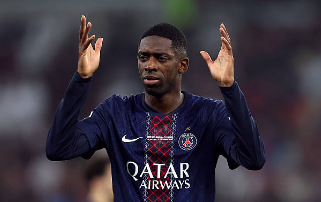
“When used properly, he could become the best player in the world.”
How best in the world Dembele finally lived up to his potential: When Xavi made that declaration in 2021, it landed with a familiar echo around Ousmane Dembele’s career. It was not the first time such faith had been expressed, nor was it the loudest. Talent, after all, had never been the issue. Belief was abundant. Conviction, however, was fractured by doubt.
- From goat herding to idol – Modric’s ‘underdog’ rise to the top
- Cristiano Ronaldo: I’m the best player in the world
- ‘We’ve got a little fat guy who will turn him inside out’ – the genius of Robertson
Many questioned whether the mercurial Frenchman would ever ascend to the summit once imagined for him, especially after arriving at Barcelona in 2017 as the second most expensive footballer in history following his £135.5m move from Borussia Dortmund. The price tag was monumental. The expectations were merciless.
What followed was not a straight road to greatness, but a winding, bruising passage marked by recurring injuries, uneven performances, and persistent scrutiny of his professionalism. For years, promise overshadowed production. Potential became a burden rather than a beacon.
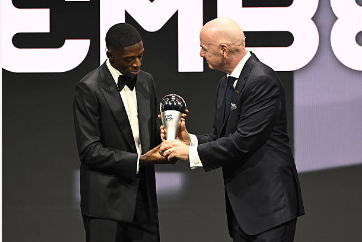
Now, at 28, Dembele stands where so many once doubted he could ever reach. Ballon d’Or winner. The ultimate individual coronation. A dream deferred, not denied.
As he stood on stage in Paris, thanking his family for the sacrifices that underpinned his journey, the tears told their own story. They spoke of frustration endured in silence, of seasons lost to treatment rooms, of internal battles waged far from floodlights. This was not a triumph born of ease. It was earned through attrition.
The foundation of that success was an extraordinary 2024–25 campaign. Dembele was the driving force behind Paris St-Germain’s historic treble, as they swept Ligue 1, the Coupe de France and the Champions League, before pushing on to the final of the Club World Cup. His output was staggering: 35 goals and 14 assists across all competitions. After a subdued opening to the season, no forward in Europe matched his form once the calendar turned.
Context magnifies the achievement further. He surpassed Mohamed Salah, whose goal involvements led Europe’s elite leagues. He eclipsed Kylian Mbappe, who scored more often. He outshone the brilliance of Lamine Yamal and Raphinha. This was not a weak field. This was a conquest.
The shift did not occur overnight. Its roots can be traced back to Barcelona, where Dembele gradually began to recalibrate his understanding of the game and his place within it. Yet it was Paris that invited him to embrace something new: centrality. Stardom. Responsibility.
Ironically, the decisive catalyst was Mbappe’s departure to Real Madrid. A move widely forecast as the one that would anoint Mbappe as the world’s undisputed best instead became the missing piece in Dembele’s puzzle. Luis Enrique’s message was blunt and liberating: goals were now Dembele’s duty. Ego was no longer a flaw it was a requirement.
Behind closed doors, the message was relentless. Ballon d’Or was no longer a distant fantasy but a recurring refrain. Convert more. Demand more. Finish what you create.
Dembele listened.
When PSG acquired him in August 2023 for £43.5m, his first season delivered steady returns six goals and 14 assists as the club claimed a domestic double. But he remained a supporting figure, orbiting around Mbappe, who struck 44 times in what proved to be his final PSG season.
With Mbappe gone, PSG needed a new axis. A new reference point. Dembele did not hesitate.
His numbers exploded. Fifty-one goal involvements more than double his previous career best. Thirty-five goals, a figure that dwarfed anything he had produced before. Luis Enrique had handed him freedom: fewer passes, sharper instincts, a striker’s hunger.
Tactically, the transformation was just as significant. Previously stationed wide, largely on the right, Dembele now operates centrally, often as a false nine. Closer to goal. More touches. Greater influence in the build-up. Crucially, more opportunities to finish. A different position, and a different mindset.
Yet reducing this evolution to Mbappe’s exit alone would be misleading. That was merely the final turn of the key.
At Barcelona, Dembele’s body betrayed him. Fourteen muscle injuries. Seven hundred and eighty-four days lost. Concerns over discipline compounded the problem. Late nights. Gaming sessions. Missed schedules. Private chefs were assigned. Fines accumulated. Still, when available, his speed and dribbling remained devastating, offering fleeting reminders of his rare gifts.
So what truly changed?
Those closest to him point not to tactics, but to life. In December 2021, Dembele married his partner Rima in Morocco. Soon after, he became a father. The news caught even teammates by surprise; few knew he was in a relationship at all.
Responsibility arrived quietly and decisively.
During his final seasons at Barcelona, maturity replaced chaos. He began working privately with a physiotherapist, travelling to France for preventative care. Nutrition became intentional, guided by a French specialist. Recovery became routine, not reactive. Fatherhood reframed priorities.
The boy with boundless talent grew into a professional with purpose.
For years, many believed PSG’s Champions League destiny would rest on the shoulders of one French superstar, who would then ascend to the pinnacle of world football. They were right about the destination, but wrong about the name.
Not Mbappe.
Ousmane Dembele.
