
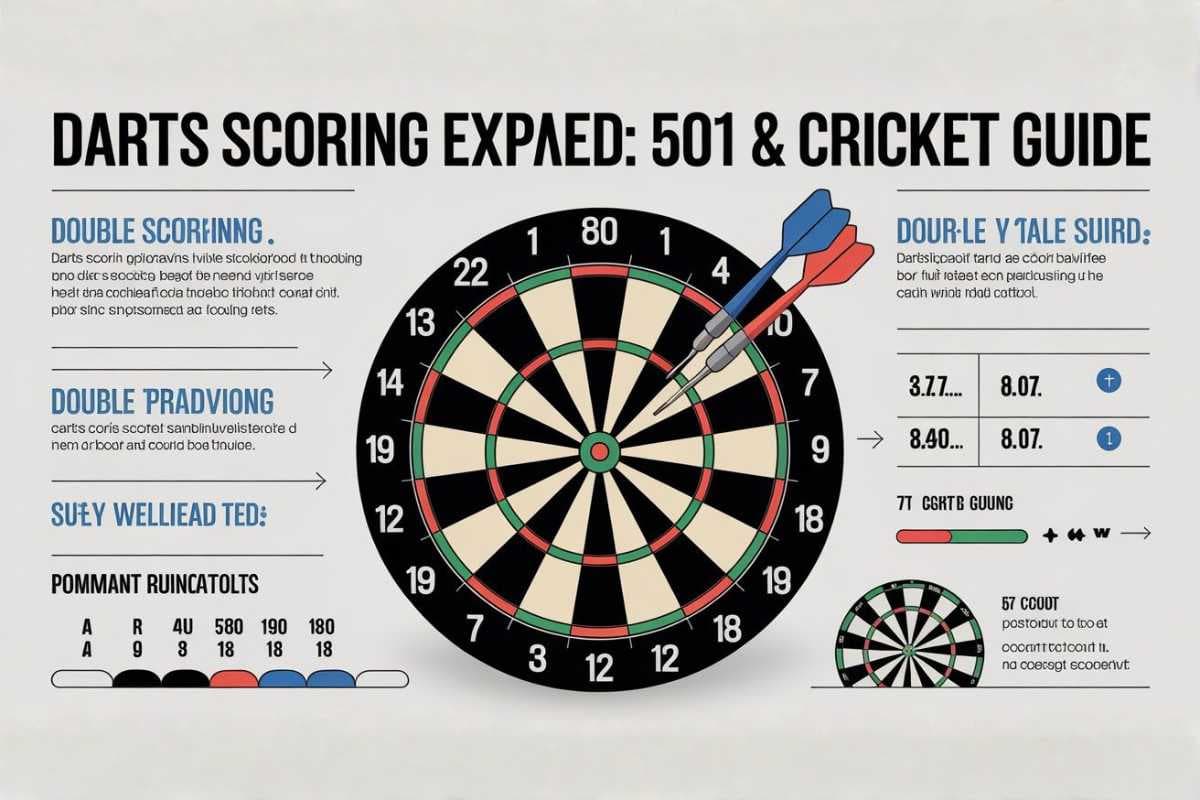
Darts scoring explained in clear simple language that’s what most players are really searching for. Whether you’re playing casually at home or watching the World Darts Championship understanding how scoring works instantly makes the game more exciting.
At first, the dartboard looks confusing. Numbers jump around. Rings multiply scores. People shout 180! and celebrate wildly. How ever once you understand how 501 and Cricket scoring works everything starts to make sense.
Let’s break it down step by step.
Understanding the Dartboard Darts Scoring System
Before learning 501 or Cricket you need to understand how the dart board itself works. A standard competition board used by the Professional Darts Corporation has 20 numbered segments arranged in a non sequential order. This unusual order punishes inaccurate throws and rewards precision.
Each number section includes:
- Single area normal score
- Double ring (outer thin ring) 2× the number
- Triple ring (inner thin ring) 3× the number
At the center:
- Outer bull = 25 points
- Inner bull (bullseye) = 50 points
For example:
Single 20 = 20 points
Double 20 = 40 points
Triple 20 (T20) = 60 points
Because of this structure T20 is the highest Darts scoring single dart on the board.
How 501 Darts Scoring Works
501 is the most popular professional format. Legends like Phil Taylor and Michael van Gerwen built their careers mastering this format.
Basic Rules of 501
- Each player starts with 501 points.
- Players throw three darts Scoring per turn.
- The score from each turn is subtracted from the total.
- First player to reach exactly zero wins.
How ever there is a critical rule that changes everything.
Double Out Rule
In most official games you must finish on a double. This is called double out. For example:
If you have 32 remaining you must hit Double 16 to win. If you hit single 16 instead you still have 16 left and must continue.
What Is a Bust?
If you score more than your remaining points you bust. When this happens your score resets to what it was at the start of that turn.
For example:
If you have 20 left and hit triple 20 (60) your score goes back to 20.
There fore players must calculate carefully before throwing.
Checkout Strategy in 501
Checkout refers to finishing the game from a remaining score. Because you must double out, strategy becomes essential.
Popular Checkout Targets
- 40 → D20
- 32 → D16
- 24 → D12
- 16 → D8
Many professionals prefer D16. If they miss inside and hit single 16 they leave D8 which is still a clean double finish.
The Maximum Checkout: 170
The highest possible finish in 501 is 170:
T20 + T20 + Bull (50)
It’s rare and electrifying when it happens on stage.
Why 180 Matters
The highest possible score in one turn is 180 (T20 × 3). High scoring early reduces pressure during checkout. How ever smart setup shots matter more than chasing 180 every turn.
Cricket Darts Scoring Explained
Cricket uses a completely different scoring system. Instead of subtracting from 501 players try to close specific numbers.
Numbers in Play
- 20
- 19
- 18
- 17
- 16
- 15
- Bull
Other numbers do not count.
How to Close a Number
You must hit a number three times:
- Single = 1 mark
- Double = 2 marks
- Triple = 3 marks
Once you hit three marks that number is closed. If your opponent has not closed it yet you can score points on it.
For example:
If you close 20 first and your opponent has not every hit on 20 adds points to your score.
How to Win Cricket
You must:
- Close all numbers
- Have equal or more points than your opponent
This makes Cricket both offensive and defensive.
501 vs Cricket: Key Differences
- 501 focuses on speed subtraction and finishing precision.
- Cricket focuses on control board aware ness and blocking opponents.
- In 501 you race to zero.
- In Cricket you manage territory on the board.
- Both require accuracy but the mind set differs completely.
Smart Scoring Tips for Better Results
- First aim for consistency rather than power. Smooth mechanics improve grouping.
- Second think two turns ahead. Set up shots matter in 501.
- Third in Cricket prioritize high value numbers like 20 and 19 early.
- Fourth practice doubles regularly. Many games are lost on missed doubles.
- Finally stay calm near check out. Rushed throws cause busts.
Common Scoring Mistakes
New players often lose control of the game by throwing without thinking ahead choosing flashy shots over smart positioning and reacting emotionally instead of following a steady scoring plan.
Many beginners:
- Forget to calculate remaining totals
- Ignore double out strategy
- Chase triples recklessly
- Fail to block in Cricket
Instead build a simple plan for each turn and stick to it.
Conclusion
Darts scoring may look complicated at first. How ever once you understand the dart board layout double out rule and Cricket closing system the game becomes logical and strategic.
In 501 smart checkouts win matches. In Cricket control and timing decide the outcome. Both formats reward planning patience and precision.
When you truly understand darts scoring you stop throwing randomly and start playing with intention. And that’s when darts transforms from a casual pastime into a skill based competitive sport built on strategy calculation and confidence.
FAQ’s
What is a set and a leg in darts?
A leg is one single game of 501, while a set is a group of legs played together in a match.
What is a nine dart finish?
A nine dart finish is the perfect leg in 501 completed in the minimum possible nine darts.
What does straight out mean in darts?
Straight out means you can finish on any segment not necessarily a double.
Are steel tip and soft tip scoring systems the same?
The basic scoring is similar but soft tip darts often use electronic boards that track scores automatically.
What is a Shanghai in darts?
A Shanghai is hitting a single double and triple of the same number in one turn.
Why are dartboard numbers arranged randomly?
The numbers are placed in a non sequential order to punish inaccurate throws and reward precision.
What does master out mean?
Master out allows players to finish on either a double or a triple.
How do professionals keep track of scores during matches?
In tournaments official scorers calculate totals manually even though electronic systems are sometimes used.
